The law is supposed to be public. Transparent. Knowable. That is what makes it law, not power.
But in 2025, the New York Civil Liberties Union had to sue the state just to find out what instructions were being given to judges behind closed doors.
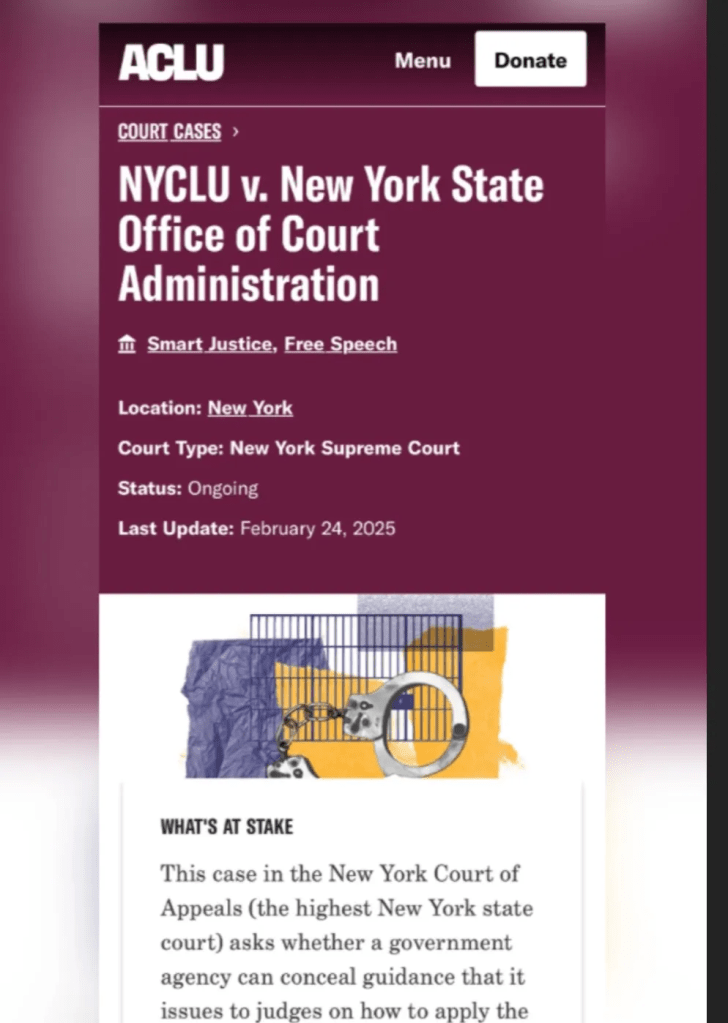
The case is called NYCLU v. New York State Office of Court Administration. And at the heart of it is a single, staggering question. What happens when judges are guided by rules that no one else is allowed to see?
For years, the Office of Court Administration in New York has issued internal directives to judges on how to apply the law. These memos and handbooks are not available to the public. Not to attorneys. Not to defendants. Not to the people whose lives hang in the balance when a gavel comes down.
And yet, those secret materials may be shaping the outcome of court cases across the state.
The NYCLU asked to see them. The state refused.
So the civil liberties group sued.
Because when rules are made in secret, due process dies in silence.
Think about what that means. A person walks into a courtroom believing the law will protect them. They hire a lawyer. They prepare their defense. They study statutes. But the judge deciding their fate may be operating with an entirely different set of instructions. Not based on public law. But on unpublished memos passed down from state officials with no public input.
This is not justice. This is shadow governance.
The public has no way to know what kind of biases or policy agendas are embedded in those directives. They cannot appeal what they cannot see. They cannot challenge logic that was never disclosed. And they cannot trust a system that runs on secrets.
This is not just a technical issue. It is a constitutional one.
The Sixth Amendment promises a fair trial. The Fourteenth promises due process. Neither can exist in a courtroom governed by hidden doctrine.
And if that sounds abstract, look around. Ask how many people have lost cases they never understood. Ask how many families sat stunned in a courtroom while a judge made decisions that seemed to come from nowhere. Ask how many defense attorneys have sensed something was off but were never able to prove it.
Secrecy breeds imbalance. It allows the state to bend the scales in its favor. And it undermines one of the most basic principles of a democratic society – that the law belongs to all of us.
This lawsuit is not about one set of documents. It is about the right to see the rules being used to judge us.
Because when courtrooms become black boxes, justice becomes whatever the state says it is. And that should terrify everyone.
The NYCLU is right to demand answers. The public is right to expect them. And every judge who truly believes in the integrity of the courts should want transparency too.
Justice cannot exist in the dark.
And the longer we allow it to, the more we risk becoming a nation where rights exist only on paper – and where courtroom outcomes are determined not by law, but by whatever memo happens to land on a judge’s desk that day.

 Light Calls To Light
Leave a comment